

The first thing I saw when I got to Mama Kike’s gate was the waterline. It was still there, three days after the rain, a brown stain running along the compound wall at roughly knee height. She was standing outside when I arrived, not doing anything in particular, just standing the way people stand when they are still processing something they cannot quite believe happened to them. She said: “Lukmon, everything inside that flat. Everything.”
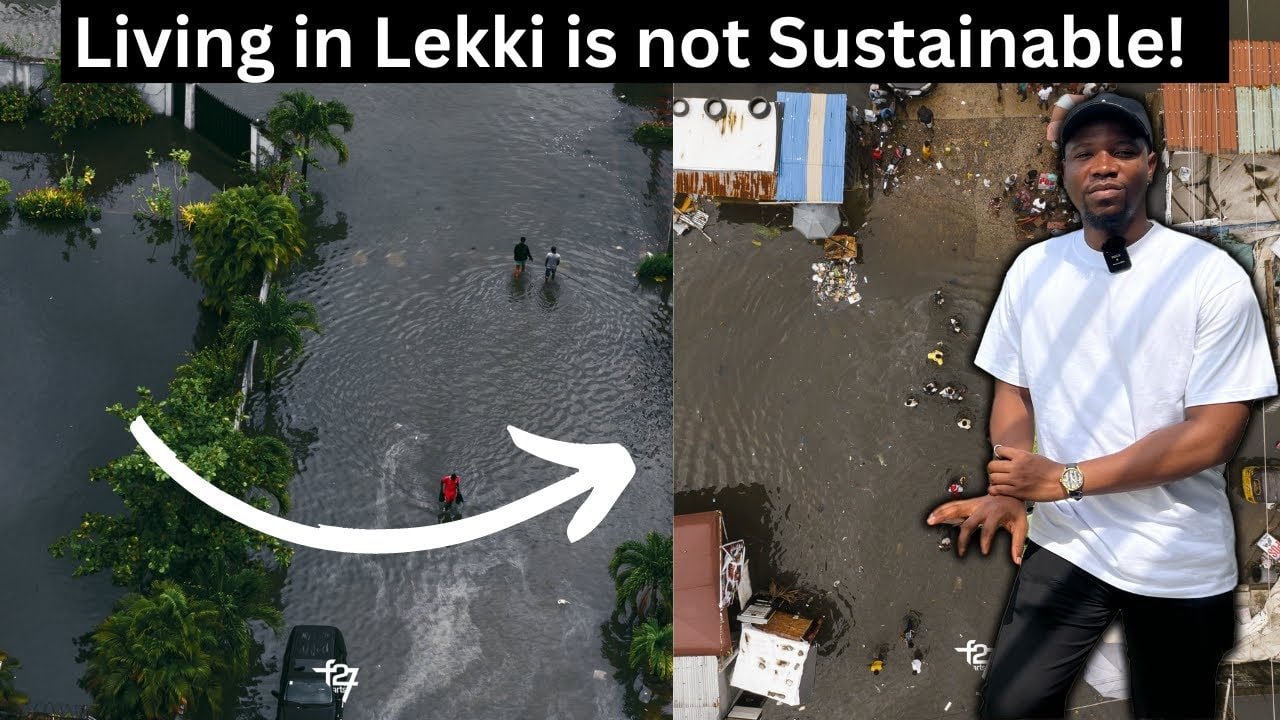
She did not mean her things. She meant her son’s things. Chidi had moved into that ground-floor flat in Abraham Adesanya Estate fourteen months earlier, paid two years upfront the way Lagos landlords demand, and in one night of heavy rain in late June, his electronics, his work documents, his mattress, a chest of drawers his mother had bought him when he first moved to Lagos from Enugu — all of it was either soaked through or ruined completely. He lost close to four hundred thousand naira in property alone, not counting the rent he had already paid for a flat that sat below road level in a compound with blocked drainage that the landlord had known about for years.
I had been down that road before. Not personally flooded, but I have sat inside enough ground-floor flats along the Ajah corridor to know the pattern. The ones that look fine in January look like a different address entirely when the rains come serious in June and July. The agent shows you the apartment in dry season. The tiles are clean, the ceiling looks solid, the windows open smoothly. What the agent does not show you is the gutter outside the gate, which has not been cleared since the last administration. What the agent does not mention is that the road was resurfaced without any adjustment to the drainage gradient, so now the street sheds water directly into the lower compounds. What the agent absolutely will not tell you is that the landlord raised the gate last year because it kept flooding, which means the compound itself is effectively a basin.
I have argued with agents over this exact thing. Sat in offices around Sangotedo and Ajah roundabout and watched them smile that particular smile — the one that means they already know what you are about to say and they have decided it is not their problem. “Flooding is everywhere in Lagos,” one told me last year. He was not entirely wrong. But everywhere in Lagos is not the same. There is flooding and there is this kind of flooding — the kind that comes because nobody who built the structure or leased it out ever had to live with the consequences of getting it wrong.
What changed my thinking about how serious this actually is was not Chidi’s story. It was his mother’s. Mama Kike told me she had been saving since 1999. Twenty years of civil service salary in Osun State, carefully put away, supplemented after she retired with a small provision shop near her house. She had given Chidi the money for that rent because she wanted him settled in Lagos, somewhere he could build from. Two years upfront in Lagos is not a small thing. For someone like her, it was everything she had accumulated since before Chidi was old enough to understand what savings meant. And all of it went into a flat that flooded inside fourteen months.
The landlord’s response, when Chidi finally reached him, was to say that “rain is an act of God.” He offered nothing. There was no clause in the tenancy agreement that addressed flooding liability because the agreement itself was one page, handwritten, and had no legal standing that any lawyer worth his call to bar would have taken seriously. I have seen that document. It is the kind of document that gets drawn up when both parties are in a hurry and the agent is standing there watching and everybody just wants the transaction to close.
Lagos will do this to you if you let it rush you. The city has a tempo that makes caution feel like weakness. Pay fast, decide fast, sign fast, because there are ten other people behind you ready to take the flat. Some of that is true. Some of it is a pressure that works entirely in favour of the landlord and the agent and nobody else.
Abraham Adesanya Estate has real value. I am not here to tell you the place is bad. There are solid blocks, well-managed compounds, landlords who respond when something goes wrong. But the estate is not monolithic and it is not uniformly safe from what happened to Chidi. The road infrastructure in some parts has not kept pace with how many structures have gone up. Water has to go somewhere.
Before you pay anything for a ground-floor flat anywhere in Ajah, go there during a rainstorm. Not after. During. Bring a torch if you need to, stand at the gate, look at where the water goes. That one hour will tell you more than three visits in dry season ever could. Nobody will thank you for taking that time. But nobody will be paying your losses either.

Lukmon Isiaq is a Lagos-based property researcher and street-level writer who has spent years studying the Ajah corridor the way most people never bother: on foot, in compounds, and in conversation with landlords, tenants, caretakers, and estate agents who operate where the listings end and the real story begins.
He is not a property developer. He is not a real estate marketer. He is the person you call before you sign anything. The one who has personally walked flood-prone streets after October rain, argued with agents over undisclosed charges, and documented how the Lagos housing market actually works for ordinary Nigerians trying to make serious decisions with serious money.
His writing on Abraham Adesanya Estate Lekki Ajah covers the Ajah corridor, Ikota Villa, Ajao Estate, Ogudu GRA, and the wider Lekki property market with one consistent standard: the honest version, not the brochure version.
He understands the gap between what a listing promises and what a tenant discovers on their first rainy season.
