




The agent sent me the listing at eleven o’clock on a Wednesday night, which is itself a kind of statement. Two billion naira. Banana Island. Five bedrooms, a cinema room, a pool that photographs well from above, and a view of the lagoon that looks like something from a development in Dubai that ran out of money before it reached the landscaping. I looked at the pictures for a long time. Then I called a driver I know who has been ferrying people in and out of Banana Island since 2017, and I asked him to take me there.
I wanted to see what two billion naira looks like when you are standing inside it.
Banana Island is not Lagos in the way that Ajah is Lagos, or Surulere is Lagos, or anywhere that requires you to negotiate a pothole at six in the morning while a danfo driver argues his philosophy at you through the window. The road in from Ikoyi is smooth. The security at the gate is alert in a way that suggests they are actually paid and actually trained, two things that should be standard and are not. The streets inside are quiet with the specific quietness of money, the kind that comes from the fact that everyone who lives there has enough of it to insulate themselves from most of the sounds of the city.
I will not pretend it is not impressive. It is.
What I was not prepared for was the driver, whose name is Emmanuel, telling me, as we idled outside the property I had come to see, that the family in the house behind it had been in a dispute with the estate management over their service charge for fourteen months. Not a small family. Not a struggling family. A family with a compound that has its own gateman and its own backup generator for the backup generator. Fourteen months of dispute over a charge that, Emmanuel said, runs close to four million naira annually per property. I asked him what happened. He shrugged. “They still dey there,” he said. “But the relationship no good.”
I filed that away.
The property I was shown is real. The cinema room has proper acoustic panelling and a screen that would not embarrass a small commercial cinema. The kitchen has imported fittings that I could not put a price on because I have never priced them. The pool is heated, which is something I did not know was a selling point in Lagos until that afternoon. The master bedroom has a bathroom the size of a decent flat in Abraham Adesanya Estate, and I say that without exaggeration, because I have stood in enough decent flats in Abraham Adesanya to know the geometry.

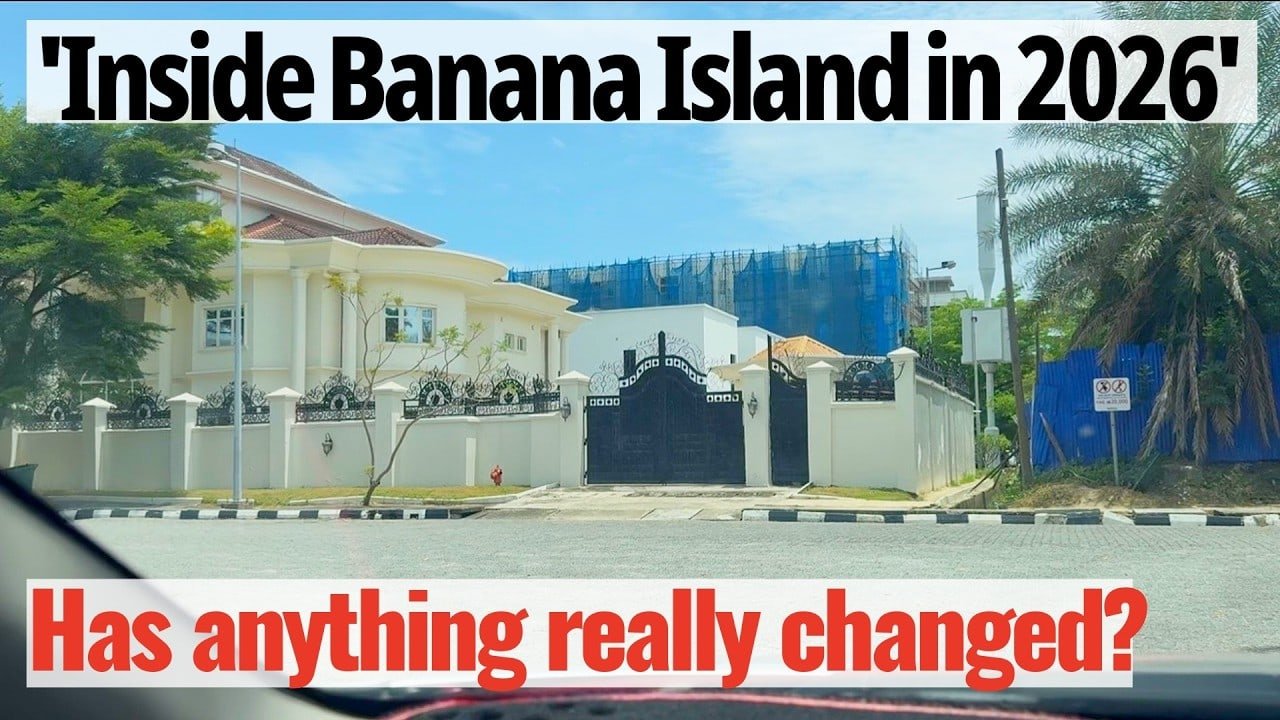
Two billion naira buys you all of that. It also buys you an address, and the address, if I am being honest with you, is doing significant work in that price.
Here is what the listing does not tell you. The Certificate of Occupancy situation on Banana Island has been complicated since the island was developed. Some titles are clean. Some have layers of assignment and sub-assignment that a competent property lawyer would want to spend real time with before you committed anything. The development was a public-private arrangement that has produced, over the years, exactly the kind of documentation ambiguity that Lagos specialises in creating and then leaving for buyers to sort out. At two billion naira, you would expect title clarity to be the first thing on the table. You would be surprised how often it is the last.
I also want to say this plainly, because the property marketing around Banana Island has been running so long it has started to smell like a catechism: a significant portion of what you are paying for is not the building. The building, depending on the property, is good to very good. But you are paying for distance. You are paying to be separated from the version of Lagos that begins on the other side of that gate, the traffic, the drainage, the generator schedule, the gateman who earns thirty thousand naira and is expected to make institutional security decisions. Inside Banana Island, those problems are managed. Outside it, the moment you turn toward Third Mainland or join the Lekki-Epe Expressway heading home, Lagos is exactly what it was before you could afford to leave it.
That is not a criticism of people who buy there. I understand entirely why someone with two billion naira to spend on property would want to buy distance. Distance is genuinely valuable in this city.
The criticism is for the marketing that sells this as a property story when it is mostly an infrastructure story. If Lagos had reliable power, functional roads, and competent drainage, Banana Island would still be expensive. It would not be this expensive.
Before you sign anything on Banana Island, even if the money is not an object, put the title documents in front of a property lawyer who has no relationship with the agent selling it to you. Pay for that lawyer yourself. The two billion can wait one more week.


Lukmon Isiaq is a Lagos-based property researcher and street-level writer who has spent years studying the Ajah corridor the way most people never bother: on foot, in compounds, and in conversation with landlords, tenants, caretakers, and estate agents who operate where the listings end and the real story begins.
He is not a property developer. He is not a real estate marketer. He is the person you call before you sign anything. The one who has personally walked flood-prone streets after October rain, argued with agents over undisclosed charges, and documented how the Lagos housing market actually works for ordinary Nigerians trying to make serious decisions with serious money.
His writing on Abraham Adesanya Estate Lekki Ajah covers the Ajah corridor, Ikota Villa, Ajao Estate, Ogudu GRA, and the wider Lekki property market with one consistent standard: the honest version, not the brochure version.
He understands the gap between what a listing promises and what a tenant discovers on their first rainy season.


