
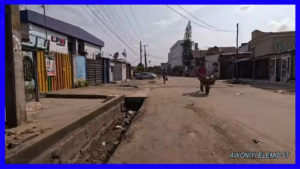
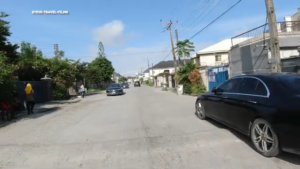




The gateman at the estate on Adewale Kolawole Crescent was still filling out the visitor’s log when the man in the yellow PHCN vest walked past him. Just walked past. The gateman looked up, saw the vest, registered what the vest was supposed to mean, and went back to the log. I was standing at the gate waiting for a caretaker, and I watched the whole thing in about twelve seconds. The man with the vest went into the compound, walked toward the back where the prepaid meters are mounted on the wall, stayed maybe four minutes, came back out. The gateman did not look up the second time.
I could not tell you if that man was a legitimate EKEDC worker or something else entirely. That is the problem. Nobody could.
I have been inside enough estates in this corridor, from Abraham Adesanya to the newer developments pushing toward Sangotedo, to tell you that the security architecture in most of them is a costume, not a system. There is a gate. There is a gateman. There is usually a barrier that lifts for cars and a logbook that records names nobody verifies. What there is not, in most of these estates, is any real protocol for the category of visitor that arrives with an institutional identity and a uniform. PHCN vest, WAEC ID card, LAWMA reflective jacket, Lagos State Ministry of Environment clipboard. These are not random criminals. These are people who have understood something specific about how estates in Lagos process authority.
They have understood that the vest does the work.
A woman I will call Titi, who lives in one of the medium-density blocks inside Abraham Adesanya Estate, told me what happened to her neighbour in March of last year. Two men came with WAEC identification, told the gateman they were doing a verification exercise for candidates registered for the May/June examinations in the estate. The gateman called nobody. The estate has a residents’ association. He called nobody. He wrote their names in the log, names which turned out to be completely fictitious, and let them in. They knocked on doors. At least three residents opened their doors and had conversations with these men inside their flats, conversations during which the men were looking at things, understanding the layout of things, noting where valuables were kept. One apartment was robbed six days later. The connection was never formally established. It did not need to be.
The thing that surprised me, when Titi finished telling me this story, was not the robbery. Robberies happen. What surprised me was when she said the gateman is still there. Same man. Same gate. Because nobody in the residents’ association wanted the argument with the estate management about who was responsible for training him, and the estate management did not want the argument with the property developer about who was supposed to have built a proper security protocol into the handover documentation. So the man is still there, lifting the barrier, reading the vests.


That is the Lagos estate economy in one paragraph. The gateman earns between thirty and fifty thousand naira a month depending on the estate and whether the residents remember to top up the security levy. He is not trained in identification verification because nobody budgeted for that training. He is not equipped with a radio or a phone linked to a central number because nobody built that infrastructure. He is given a logbook and a barrier and the reasonable expectation that a yellow vest means electricity board and a WAEC ID means government. He is one man standing at a gate making institutional judgements about strangers with props, and everybody upstream from him has decided that is sufficient.
It is not sufficient. It has not been sufficient for years. The criminals targeting residential estates in the Ajah corridor have worked this out with a clarity that estate management associations have not matched.
What I know is this. The PHCN distribution companies, Eko Electricity in particular, do not typically send meter readers without prior notice to the estate management or the residents’ association. If a man in a yellow vest arrives unannounced and wants access to interior parts of your compound, especially to individual flats rather than communal meters, that is not standard procedure. WAEC does not conduct door-to-door candidate verification inside private residential estates. Full stop. There is no such exercise. If someone arrives at your gate with a WAEC ID card and a reason to enter your flat, that reason has been invented for the purpose of entering your flat.
Call the relevant body directly. Not the number the visitor gives you. The publicly listed number. Ask if there is an exercise happening in your area today. It takes three minutes and it has no downside.
Your gateman is not the last line of defence. He was never designed to be. You are.


Lukmon Isiaq is a Lagos-based property researcher and street-level writer who has spent years studying the Ajah corridor the way most people never bother: on foot, in compounds, and in conversation with landlords, tenants, caretakers, and estate agents who operate where the listings end and the real story begins.
He is not a property developer. He is not a real estate marketer. He is the person you call before you sign anything. The one who has personally walked flood-prone streets after October rain, argued with agents over undisclosed charges, and documented how the Lagos housing market actually works for ordinary Nigerians trying to make serious decisions with serious money.
His writing on Abraham Adesanya Estate Lekki Ajah covers the Ajah corridor, Ikota Villa, Ajao Estate, Ogudu GRA, and the wider Lekki property market with one consistent standard: the honest version, not the brochure version.
He understands the gap between what a listing promises and what a tenant discovers on their first rainy season.


